

The Wrong Question
Summer Special Edition — Part II | Edition 29

NeuroEdge Nexus
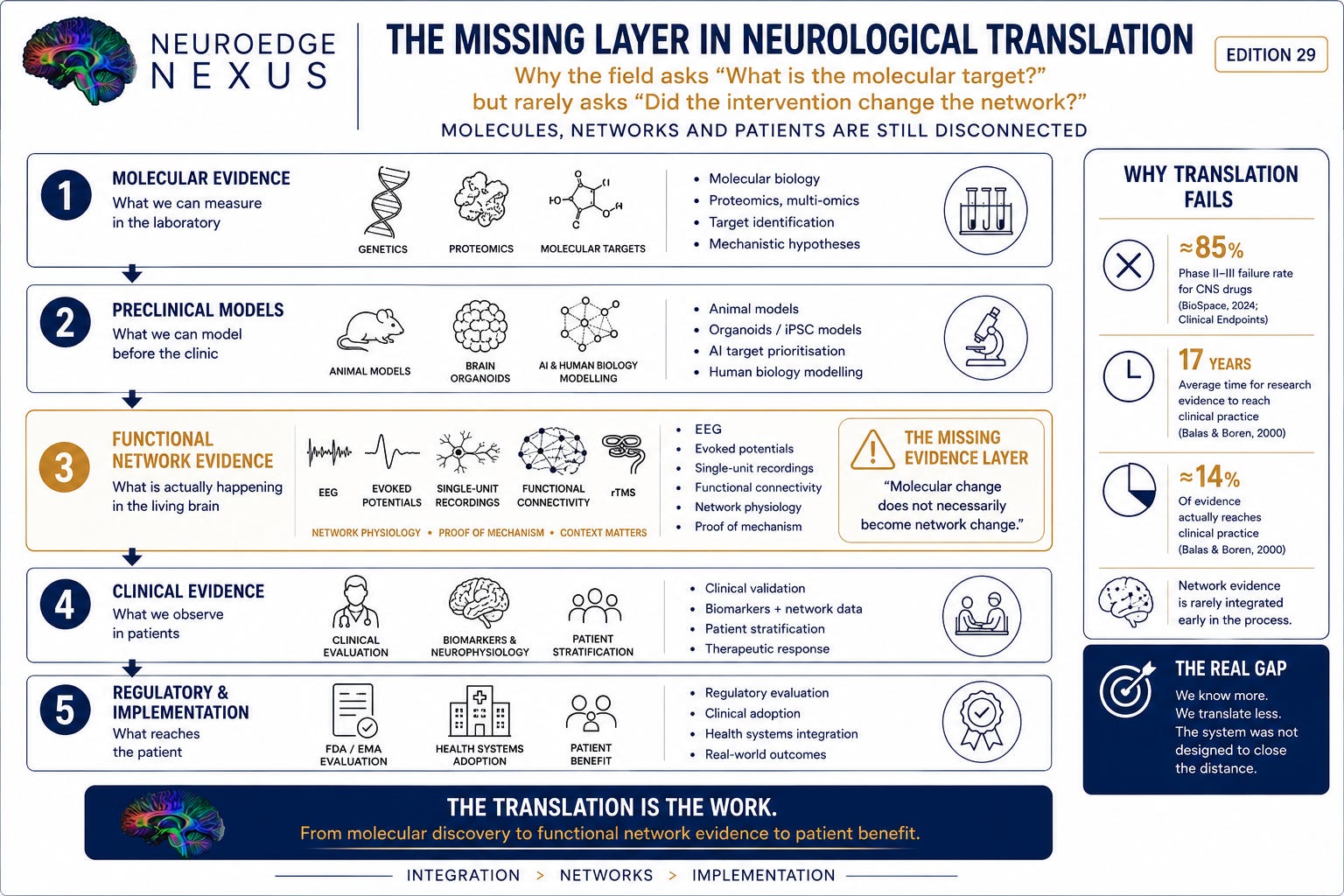
Part I of this series ended with a specific claim: that what clinical neuroscience is missing is not innovation, but integration. We followed a single discovery Llinás’s finding that neurons are self-sustaining electrical generators whose rhythms synchronise across distant regions of the brain — all the way to what it means for epilepsy surgery in 2026. The argument was that disease doesn’t live in a single anatomical place. It lives in the relationship between places, in the conversation between groups of neurons whose rhythms have fallen into an abnormal pattern. That shift has consequences well beyond epilepsy. This edition is about one of the most important of them.
There are two numbers worth holding at the start of this argument.
The Phase II and III failure rate for drugs targeting the central nervous system is approximately 85%. That figure has not moved substantially in decades. (BioSpace, 2024) On average, it takes seventeen years for research evidence to reach clinical practice, and only about 14% of it gets there. (Balas & Boren, 2000)
These are not numbers about bad science. The science is often very good. They are numbers about a system that was never fully designed to move what the laboratory understands toward the people who need it. And in neurology specifically, the point where that system breaks most consistently is not at the molecular end (where the tools have become extraordinary) but somewhere in the middle: in the step between what a genetic or molecular finding shows, and what it actually produces in the living network of a patient’s brain.
That gap is what this edition is about.
I want to explain where this argument comes from, because the timing matters — and because it is not biography.
During my residency in clinical neurophysiology at Ramón y Cajal University Hospital, I spent my late afternoons as an observer at the Cajal Institute . These are two separate institutions that share a name, and that name belongs to Santiago Ramón y Cajal — Nobel Prize in Physiology or Medicine 1906, the Doctor who described the neuron as the fundamental unit of the nervous system, whose illustrations remain scientifically accurate more than a century later.
The Cajal Institute holds his legacy: his original drawings, his instruments, the physical record of what one mind understood about the nervous system. The hospital that carries his name holds the patients.
In those months I moved between them daily. The researchers at the Cajal Institute were working at extraordinary depth, specific questions, rigorous methods, science that takes years to build. The patients I was learning to evaluate at the hospital had exactly the same pathologies those researchers were studying. Most of what I observed in those late afternoons would never reach those patients. Not because the science was wrong. Because the path connecting the two didn’t exist in any coherent form.
I mention this not as personal context but because it is a precise, verifiable illustration of the structural argument this article makes: two institutions carrying the same name, studying the same diseases, operating in separate worlds. Not a metaphor. A fact. And one that points directly at the nature of the problem — not a shortage of scientific depth, but an absence of the architecture that connects that depth to the patient.
That absence is why NeuroEdge Nexus exists. And it is the tension this article is about.
Before my residency in Madrid, during medical school in Bogotá, Dr. Fabio Andrés Rodríguez Cely taught me biochemistry, molecular biology, and genetics — not as a sequence of isolated chapters but as a single continuous thing. The molecule connecting to its function, the function to its physiological consequence, the consequence to what you eventually observe in a patient. He was, simultaneously, Medical Director at major pharmaceutical companies — a scientist who understood how industry worked from the inside, and who never let the molecule exist without its downstream meaning.
I raise this here — a teacher from more than twenty years ago — because what he was describing then is precisely what the translational pipeline of 2026 still does not do systematically. The integration of molecular biology, protein function, physiology, and clinical consequence as a single continuous chain of evidence, not as parallel tracks that occasionally intersect. The problem he was teaching against is the same problem the 85% describes. The timing is not coincidence. It is evidence that this is not a new failure.
What Llinás demonstrated — first at the level of a single neuron in 1988, then across whole-brain networks in 1999 — is that neurological disease is not primarily a molecular event. It is a network event. The same disrupted conversation between the thalamus and the cortex appeared across chronic pain, tinnitus, Parkinson’s disease, and depression — conditions that share almost no molecular features, but share the same functional network pathology. (Llinás et al., PNAS, 1999)
This has a direct implication for how we evaluate whether a therapeutic intervention works. If the disease lives at the level of the network conversation, then evidence that a drug changed a protein or a pathway is not the same as evidence that it changed the conversation. The molecular finding and the functional network finding answer different questions. One does not substitute for the other.
And yet the dominant translational framework is still built almost entirely around the molecular side of that equation.
Genetics tells you what could change. Proteomics tells you what is changing at the molecular level. Organoids model what might happen in human neurons under controlled conditions. These are meaningful advances — multi-omics integration, patient-derived iPSC models, AI-assisted target prioritization bring human biology earlier into the process, and in my opinion the direction is right.
But none of these tell you what is actually happening in the functional network of the living patient.
If we can analyse what is occurring at the genetic and molecular level in a neuron, but we are not simultaneously measuring the neurophysiological response of that neuron and its network, then we do not actually know whether the change we produced at the molecular level is the one generating the consequence we are aiming for. That chain of evidence has a gap exactly in the middle — between the molecule and the network function — and it is in that gap that most of the 85% disappears.
In clinical practice, that gap has a form that anyone who has worked in neurophysiology long enough will recognise.
I have evaluated patients whose molecular profile — amyloid burden, inflammatory markers, biomarker ratios — indicated advanced pathology, while their functional neurophysiology was more intact than those numbers would have suggested. And the reverse: patients with modest biomarker profiles showing severe network disorganisation on EEG, markedly abnormal evoked potentials across multiple modalities, functional evidence of breakdown that the molecular picture alone would not have predicted.
The molecule and the network were not telling the same story. In my experience, they often don’t. And the clinical decision — the real one, the one that matters to the patient — cannot be made from one without the other.
This is not a theoretical observation. It is what Rodríguez Cely’s integrated way of seeing predicts, and what Llinás’s network model of disease explains: that the molecular finding and its functional consequence are related but not identical, and that assuming one from the other is where the chain of evidence breaks.
The tools for measuring the network side of this equation already exist. This is not an argument for developing something new. It is an argument for where in the pipeline tools that already exist should be applied — and why their absence at early development stages is not a technical limitation but a structural choice with measurable consequences.
An EEG does not tell you which protein changed. It tells you whether the network changed — whether an intervention reached the level where, as Llinás showed, the disease actually lives. Designed into a trial from the beginning rather than added at the endpoint, it is not a monitoring instrument. It is a proof-of-mechanism instrument.
Evoked potentials — somatosensory, visual, auditory, motor — tell you whether a specific pathway is conducting and integrating. Not a molecule. A circuit, measurable and reproducible, regulatory-grade when properly designed into a protocol.
Single-unit neuronal recording goes further still: the firing pattern of an individual neuron within its local network, its temporal relationship to neighbouring cells. This is the scale at which a molecular change either becomes a functional change or disappears — where the protein story either translates into network behaviour, or doesn’t, and you need to know which before committing to a Phase III.
And repetitive TMS, beyond its therapeutic applications, offers something that remains underused as a research instrument: a non-invasive window into cortical excitability and plasticity in the living human brain. A 2025 paper in Neuron showed that high-frequency rTMS applied to primary motor cortex reverses the excitation-inhibition imbalance in the S1-M1 microcircuit, restoring glutamatergic neuronal activity — not by targeting a molecule, but by operating directly at the network level. (Wang et al., Neuron, 2025) That result matters here not primarily as a therapeutic finding, but as a demonstration that network-level change is measurable, non-invasively, in humans — and that molecular and functional evidence can be generated simultaneously, not sequentially. That simultaneity is precisely what the current pipeline is missing.
I have worked with these instruments across more than thirteen years of clinical practice. What they generate is a layer of evidence that no omics platform produces, and that regulators at both the FDA and EMA are increasingly asking for: real-world evidence that an intervention changed something meaningful in the patient’s nervous system, not only in a biomarker panel.
A 2024 study in Neurology found that 46% of Phase III trials for neurological diseases were launched without a preceding positive Phase II result. Programs that advanced without solid Phase II foundations showed a 31% positive outcome rate. Those built on them reached 57%. (Moyer et al., Neurology, 2024)
The difference between 31% and 57% is not explained by molecular science. It is explained by the quality of the translational evidence built before the Phase III commitment was made — and the most consistent absence in that evidence is functional network validation at the stages where it would most change decisions.
Both the FDA and EMA are asking for this with increasing specificity. That is not new regulatory preference. It reflects what the science has been pointing to since Llinás published in 1999, and what Rodríguez Cely was teaching long before that: that the molecule and its functional consequence are not the same thing, and that a pipeline which measures one without the other is not measuring what it thinks it is measuring.
The path from a discovery to a patient is long. It passes through scientific validation, regulatory review, institutional adoption, clinical implementation — each layer with its own logic and timeline. Most evidence does not survive all of them. Seventeen years. Fourteen percent.
That is not a failure of science. The science exists. The effort is genuine. What it describes is a gap in the evidence architecture — specifically, in the step between molecular discovery and functional network validation: between what happens in a gene or a protein, and what that change produces in the network of a living patient’s brain.
The wrong question is whether we have enough molecular evidence. We often do.
The right question is whether the evidence connects the molecule to the network to the patient — whether the change produced at the molecular level is actually the one generating the consequence we are aiming for, measured in a way that holds under regulatory scrutiny and translates into something a clinician can act on.
Cajal described the neuron. The Cajal Institute and the Ramón y Cajal Hospital carry his name and, more than a century later, still largely operate in separate worlds. The science in one building and the patient in the other. That separation is not inevitable. But closing it requires something the pipeline has not yet built systematically: the simultaneous measurement of what changes at the molecular level and what that change produces in the network.
That is the missing layer.
Part III will examine what building it would actually require — and why the barrier is not scientific but structural, a governance one
Part I examined thalamocortical dysrhythmia and what the network model of disease means for epilepsy surgery in 2026. Part III will examine what a regulatory-grade functional biomarker framework for neurological drug development would need to include — and why building it is less a question of scientific capability than of how the system is designed.
🔗 neuroedgenexus.com
References
Kola I, Landis J. Can the pharmaceutical industry reduce attrition rates? Nat Rev Drug Discov. 2004;3(8):711–6. DOI: 10.1038/nrd1470
Balas EA, Boren SA. Managing clinical knowledge for health care improvement. Yearb Med Inform. 2000;9(1):65–70. DOI: 10.1055/s-0038-1637943
Llinás RR. The intrinsic electrophysiological properties of mammalian neurons: insights into central nervous system function. Science. 1988;242(4886):1654–64. DOI: 10.1126/science.3059497
Llinás RR, Ribary U, Jeanmonod D, Kronberg E, Mitra PP. Thalamocortical dysrhythmia: a neurological and neuropsychiatric syndrome characterized by magnetoencephalography. Proc Natl Acad Sci USA. 1999;96(26):15222–7. DOI: 10.1073/pnas.96.26.15222
Moyer H, Mellett R, Vigneault K, McKeown M, Karlawish J, Augustine E, et al. Prevalence and impact of bypassing or overriding phase 2 trials in neurologic drug development. Neurology. 2024;103(1):e209533. DOI: 10.1212/WNL.0000000000209533
Wang F, Tian ZC, Ding H, Yang XJ, Wang FD, Ji RX, et al. A sensory-motor-sensory circuit underlies antinociception ignited by primary motor cortex in mice. Neuron. 2025;113(12):1947–68. DOI: 10.1016/j.neuron.2025.03.027